

See how strong your tests really are—not just how much code they exercise.
Most engineering teams rely on line coverage to measure test quality. It’s the standard metric in CI pipelines. It’s easy to track. It’s widely understood.
But there’s a problem:
Line coverage tells you what was executed—not whether your tests would catch a real bug.
Today, we’re launching Diffblue Test Quality Agent—a free tool that helps you understand how effective your tests actually are.
The gap most teams can’t see
If your test suite shows:
- 75–85% line coverage
- Healthy CI pipelines
- Passing builds
…it’s easy to assume your code is well tested.
But line coverage alone doesn’t tell you:
- Whether assertions are relevant and strong enough to catch bugs
- Whether the 15-25% uncovered lines aren’t actually your most critical business logic
- Whether branching logic and error handling are adequately covered
In practice, many teams measure that their tests execute code—but they don’t know whether the tests effectively protect it.
A better way to measure test quality
Diffblue Test Quality Agent gives you a clearer answer to a more important question:
If your code broke, would your tests catch it?
To do that, it combines multiple signals into a single analysis:
- Line coverage → what your tests execute
- Branch coverage → how much logic they explore
- Test strength → a measure of the effectiveness of those tests that you’ve got
- Mutation score → an overall measure of the bug-catching ability of your test suite
The power of mutation testing
Mutation testing introduces small, controlled changes into your code and checks whether your tests fail.
If they don’t, that’s a gap.
It’s one of the most reliable ways to predict whether tests may be able to detect defects—but it’s rarely used in everyday workflows because it’s been too complex to set up or time-consuming.
Diffblue Test Quality Agent makes it simple.
What you get in one run
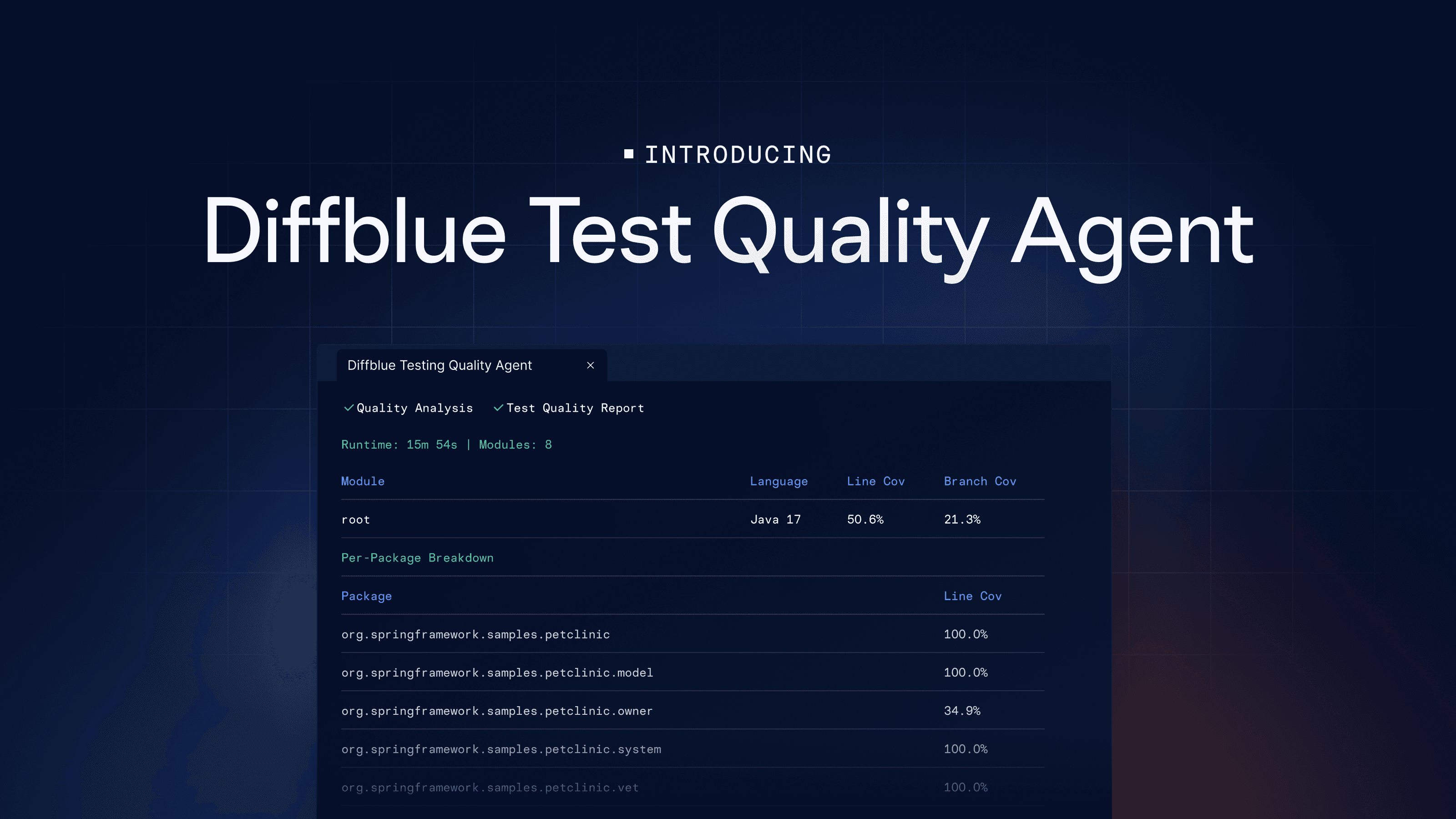
Run the agent on your Java or Python project and you’ll receive a structured report showing:
- Line and branch coverage metrics across your codebase
- Test strength indicators
- Mutation score per class
- Clear signals of where your tests are strong—and where they’re not
The result is a complete picture of your test suite.
What teams typically discover
Across real-world projects, the patterns are consistent:
- High coverage often hides weak tests – such tests waste developers’ time and unnecessarily inflate CI bills
- Critical modules can have the lowest defect detection
- Test quality varies significantly across the same codebase
- There are strong tests in certain areas, but not enough of them
In other words:
“Green CI” doesn’t always mean “safe to ship”
Built for real engineering workflows
Diffblue Test Quality Agent is designed to fit naturally into how teams already work:
- Works with Java and Python projects
- Automated setup
- Free to use, with no barrier to getting started
- Generates reports suitable for engineering reviews and audits
Whether you’re an individual developer or part of a large engineering organisation, you can run a full assessment in minutes.
From insight to action
Once you can see where your tests fall short, the next step becomes obvious:
Improve them.
Many teams use the output of the Test Quality Agent to:
- Prioritise high-risk areas
- Strengthen weak tests
- Prepare for audits or quality reviews
And for teams looking to move faster, it creates a natural path to automated test generation—helping you close gaps without manual effort.
Try it on your codebase
If you’ve ever wondered whether your tests are giving you real confidence—or just good-looking metrics—this is the easiest way to find out.
Run Diffblue Test Quality Agent on your project and get a complete view of your test quality in minutes.
Run your free test quality report.