

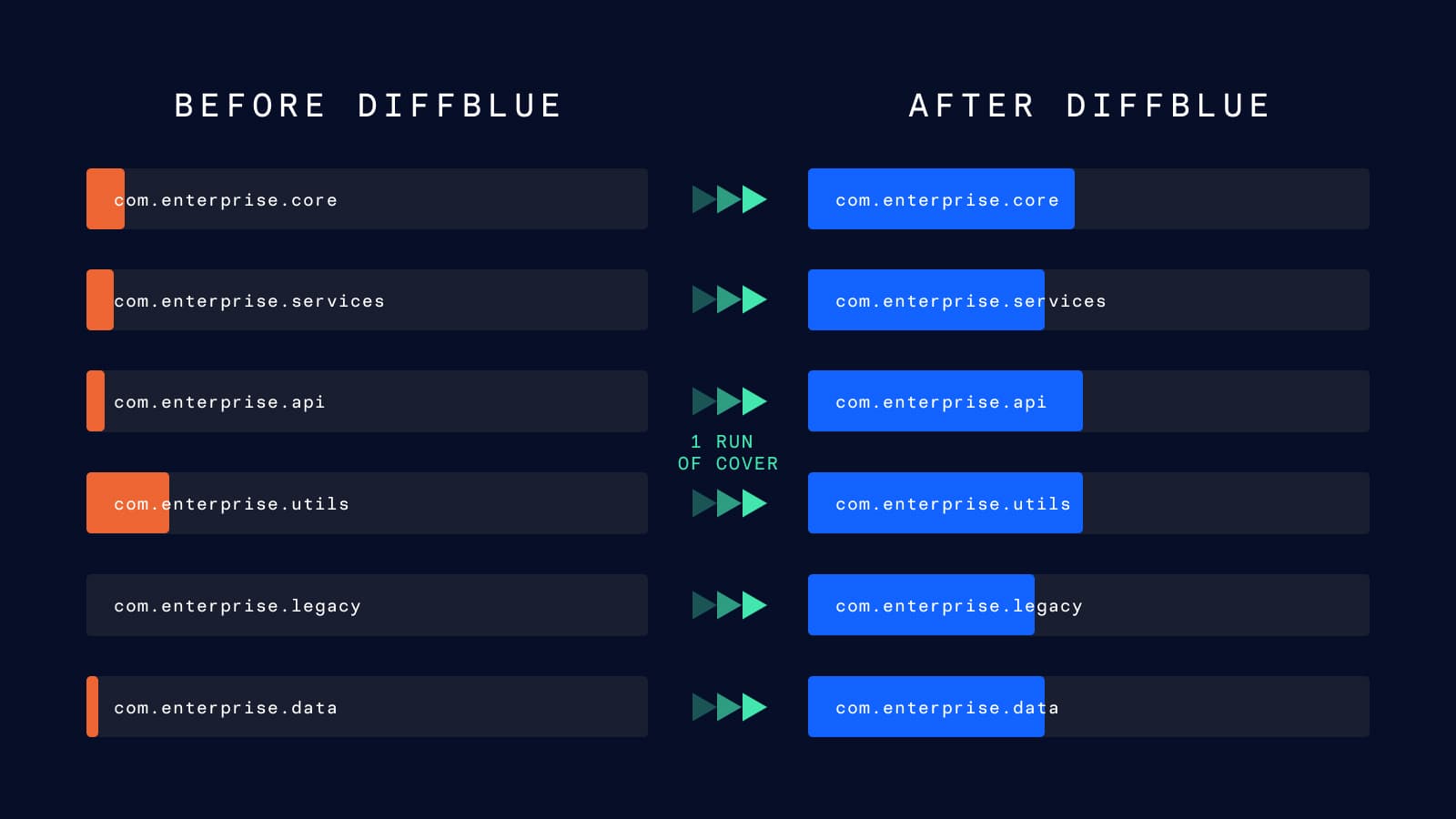

The gap between code written and code tested represents one of the most persistent challenges in enterprise software development. While Java teams understand the value of comprehensive test coverage, the reality of legacy codebases, tight deadlines, and complex business logic often leaves critical code paths unprotected.
Key Takeaways
- Automated Regression Testing: Diffblue Cover autonomously generates Java unit tests that capture and protect current code behavior.
- Reinforcement Learning: Unlike LLMs, the engine uses a reinforcement learning loop to guarantee 100% compiling and passing tests with no hallucinations.
- Immediate Value: Users typically see a 50-70% increase in test coverage out of the box without manual intervention.
- Behavioral Documentation: Tests document actual system behavior, serving as a reliable safety net for refactoring legacy code.
For Java teams tackling legacy coverage gaps or CI velocity goals, Diffblue Cover offers an automated path to production-grade unit tests, out of the box. This article briefly describes how Diffblue Cover achieves this (with some peeks under the hood) to help users gain the most benefit with the least effort and intervention.
Please note that this article primarily focuses on bulk use and initial coverage. It does not explore how to improve coverage, even in the simplest scenarios, or how to leverage developer skills and time. For the immediate steps after your first run of cover, our Guided Coverage Improvement initiative can often double initial coverage runs.Furthermore, reporting and metrics for project insights are outside the scope of this article.
We start with a Java project that builds and may (or may not) already have tests. We shall also assume that Diffblue Cover CLI is installed, configured, licensed, and pre-flight checks have been completed and actioned. (The goal here is to focus on how Diffblue Cover generates tests and how to interpret them.)
From Bytecode to Behavioral Tests: The Diffblue Approach
Diffblue Cover operates on a revolutionary principle: instead of requiring developers to describe expected behavior, it discovers and documents actual behavior through autonomous analysis. This approach transforms test generation from a creative exercise into a systematic, reproducible process.
Discovery and Analysis
Running dcover create at the root of the project will instruct Diffblue Cover to create tests for the entire project. Let’s explore how Diffblue Cover proceeds.
- Project Discovery: Cover identifies the project structure and environment, recursively exploring modules in multi-module projects.
- Method Scanning: It focuses on a module and scans all class files, iterating through each class to identify methods for test generation.
- Analysis & Context: Cover examines built class files, performing static and dynamic analysis while pulling in dependency context and custom inputs to inform test creation.
Diffblue Cover also has (and can be augmented with) knowledge useful for test generation (further information can be found here).
The Reinforcement Learning Engine
At the heart of Diffblue Cover lies a reinforcement learning system that iteratively improves test quality. Unlike template based, pattern-matching, or stochastic guessing (LLM) approaches, this learning loop creates genuinely intelligent test generation:
- Initial Prediction: Using static analysis and domain knowledge, Cover predicts an initial test scenario
- Execution and Evaluation: The test runs against actual code, capturing results and behavior
- Learning and Refinement: Results feed back into the learning model, informing better predictions
- Iteration: The cycle continues until optimal coverage and quality metrics are achieved
This approach ensures a critical guarantee: every test Diffblue Cover produces will compile and pass. There are no hallucinations, no failing tests, no manual fixes required. The reinforcement learning loop validates each test through actual execution before accepting it.

Understanding Diffblue-Generated Tests
The tests created by Diffblue Cover serve a specific, valuable purpose: they are regression tests that capture and protect current behaviour. This distinction is crucial for understanding their role in your testing strategy.
What do Diffblue Cover tests assert?
One question that arises from running Diffblue Cover is: what do Diffblue Cover tests assert? The best way to understand the answer is to go back up the stack of how the tests are generated.
For the test to compile and pass, Diffblue Cover must have created a test that accurately asserts on the current behaviour of the code. The tests will have been chosen to maximise code and branch coverage, as well as to improve quality metrics (including, but not limited to, assertion information gain, assertion depth, value quality, etc.), ensuring the highest level of test quality.
To maximise metrics such as coverage, Diffblue Cover creates tests that exercise different lines of code and branches. The reinforcement learning loop generates tests using information gathered from two key sources:
- Pre-reinforcement analysis: Static code analysis and domain knowledge.
- Runtime analysis: Dataflow/taint analysis and execution results.
All of these inputs feed into the learning loop to iteratively improve test quality.
The Value of Behavioral Documentation
Diffblue Cover uses the information in the code and from execution to identify inputs and structures, then builds a test accordingly. In practice, this means Cover will test exactly the current behaviour of the code.
The conclusion from this is that the unit tests created by Diffblue Cover using this approach are not just tests; they are effectively correct regression tests. They will compile, run, and detect regressions, giving you the confidence that your code is thoroughly tested.
One very important corollary to creating tests using Diffblue Cover is that the tests will not require code review.
Note that this article focuses on bulk out-of-the-box test creation and regression testing. This limits the test generation capabilities in favour of a fast untended coverage uplift.
Diffblue tests assert the observable behavior of your application at the unit level. That includes:
- Method inputs & return values
- State changes (field mutations)
- Exception-throwing behavior
- Control flow (branch coverage)
Real World Performance: What to Expect
Typical Out-of-the-Box Results:
Diffblue Cover is a powerful tool for test creation that can massively uplift test coverage out of the box. Simply configuring Cover and running it over a project without further tuning or intervention can provide a significant increase in coverage and a correct safety net to catch regressions. When applied to enterprise Java projects, Diffblue Cover typically delivers:
- 50-70% test coverage increase in a fraction of the time manual writing would require
- 100% passing tests that accurately reflect code behaviour
- Immediate regression protection for previously untested code
- Significant time savings for development teams
Intelligent Failure Handling
When Diffblue Cover cannot generate tests, it provides actionable diagnostics rather than a silent failure:
- “Getter or setter missing for field X” – suggests simple refactoring opportunities
- “Cannot instantiate due to abstract class” – identifies architectural constraints
- “Non-deterministic behaviour detected” – flags code requiring human review
These testability insights serve as a roadmap for improving code quality beyond just test coverage.
Further, Diffblue Cover can also produce a prioritised list of things to do that will resolve project problems and improve testability. Each item in this list includes a prompt that is human or agentic AI ingestible, allowing easy action to progress.
Conclusion
Diffblue Cover represents a fundamental shift in how we approach test coverage. Rather than viewing tests as a manual burden, it transforms them into an automated safety net that scales with your codebase. The reinforcement learning approach ensures tests remain meaningful and maintainable, while the focus on regression testing provides immediate, practical value.
For Java teams struggling with coverage gaps, velocity constraints, or legacy code challenges, Diffblue Cover offers a path forward that doesn’t require compromising quality for speed.
For further information on advanced usage scenarios, including improving code coverage and integrating Cover with CI or as an IDE agent, visit our documentation site.